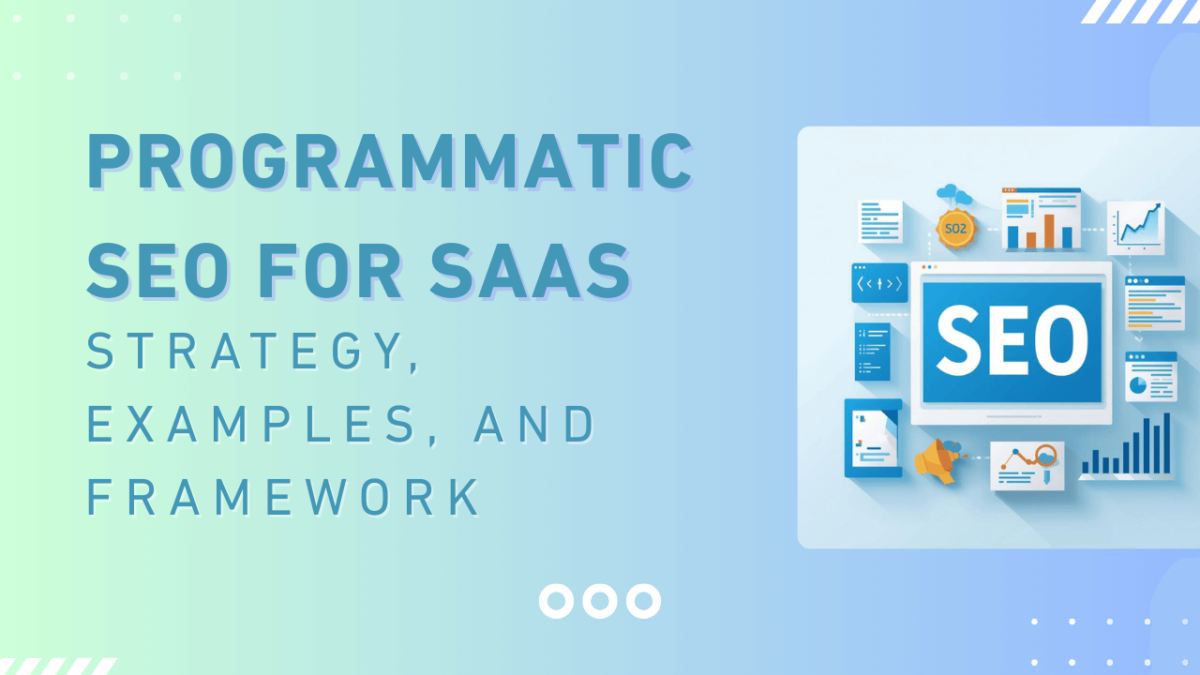
What Programmatic SEO Means for SaaS
Programmatic SEO for SaaS is the practice of generating large sets of pages from structured data, where each page exists because a specific data variation meaningfully changes the answer to a search query.
If the data changes, the page changes.
If the data disappears, the page loses its reason to exist.
That distinction matters.
Programmatic SEO ≠ “Publishing at Scale”
Most confusion comes from lumping three very different things together:
| Approach | What actually scales | What changes per page |
| Programmatic SEO | Data + logic | The answer itself |
| Scaled content | Writing effort | Mostly phrasing |
| Templated blog pages | Layout | Editorial content |
Programmatic SEO is data-dependent.
Scaled content is effort-dependent.
Templated blogs are process-dependent.
Only the first creates new information per URL.
The Litmus Test SaaS Teams Miss
A simple test to identify true programmatic SEO:
If you remove the structured data input, does the page still provide unique value?
- Yes → It’s scaled content
- No → It’s programmatic SEO
This test immediately eliminates most “programmatic” pages that are just rewritten explanations.
Why SaaS Is a Natural Fit (and a Dangerous One)
SaaS companies are uniquely suited to programmatic SEO because they already operate on structured entities:
- Integrations
- Use cases
- Industries
- Features
- Comparisons
These entities map cleanly to repeatable search patterns.
But SaaS is also uniquely exposed to failure.
At scale:
- Thin value becomes thin everywhere
- Authority gaps multiply across thousands of URLs
- Indexation mistakes affect the entire site, not a few pages
Programmatic SEO doesn’t hide weaknesses. It amplifies them.
The Constraint That Makes or Breaks SaaS Programmatic SEO
For SaaS, programmatic SEO only works when:
- Each page answers a specific query better than existing results
- The data creates information competitors don’t already provide
- The pages reinforce — not replace — core editorial SEO assets
Without those constraints, scale becomes noise.
Bottom line: For SaaS, programmatic SEO is not a content shortcut.
It’s a data-backed coverage strategy that rewards precision and punishes laziness at scale
Programmatic SEO Works for SaaS When These Conditions Exist
Treat these as non-negotiable preconditions.
If one is missing, results degrade fast.
1. You Have Structured Data That Changes the Answer
Programmatic SEO only works when each page exists because a data input meaningfully alters what the user needs to know.
Examples of valid data inputs:
- Integrations
- Use cases
- Industries
- Features
- Entities (tools, platforms, formats)
If the data does not change the answer, it does not justify a new page.
2. Search Intent Is Repeatable
Successful SaaS programmatic SEO relies on recurring query patterns, not keyword variations.
Good signals:
- The same intent appears across many modifiers
- Competitors already rank with multiple similar pages
- SERPs show lists, comparisons, or structured answers
Bad signal:
- You are inventing pages hoping demand exists
3. Each Page Delivers Clear, Isolated Value
Every page must be able to answer this question:
What does this page explain that no other page on the site explains better?
If the answer is vague or shared across pages, scale will amplify redundancy.
Programmatic SEO Fails for SaaS in These Situations
Most failures happen after launch, not before.
Thin Value Pages
If pages differ only by headings, examples, or wording, Google treats them as near-duplicates — even if templates are technically unique.
Thin pages don’t just fail to rank. They consume crawl budget and dilute site-wide trust.
No Differentiation From Existing SERPs
Programmatic SEO fails when pages restate what already exists.
If competitors already provide:
- The same data
- The same comparisons
- The same explanations
Then scaling pages only increases content parity, not advantage.
Authority Gaps at Scale
Programmatic SEO magnifies authority issues.
If the domain:
- Struggles to rank editorial pages
- Lacks topical authority
- Relies heavily on branded traffic
Then thousands of programmatic pages expose that weakness rather than compensate for it.
Quick Decision Filter (Use This Before Building Anything)
If you can answer yes to all three, programmatic SEO is viable:
- Do we have structured data that changes the answer per page?
- Does real search demand repeat across those variations?
- Can each page justify its existence on its own?
If any answer is no, the correct move is not yet, not “optimize harder.”
Bottom line: Programmatic SEO works for SaaS when it is used to systematically answer repeatable questions better than anyone else. It fails when scale is used to compensate for missing value, authority, or differentiation.
Why SaaS Companies Use Programmatic SEO
SaaS companies use programmatic SEO when the goal is coverage and leverage, not just rankings. It’s a way to turn structured knowledge about a product, its use cases, and its ecosystem into scalable organic visibility.
This is not about publishing more pages.
It’s about capturing demand that already exists but is too fragmented to target manually.
1. Coverage of Long-Tail Demand at Scale
Most SaaS search demand lives in the long tail:
- Use-case variations
- Industry-specific needs
- Integration-based queries
- Feature-modifier searches
Individually, these queries are low volume. Collectively, they represent a large share of qualified demand.
Programmatic SEO allows SaaS teams to:
- Cover thousands of intent-consistent queries
- Match users at the exact context they’re searching in
- Do so without writing thousands of one-off pages
The outcome: incremental traffic that compounds instead of cannibalizing core pages.
2. Faster Expansion Into Adjacent Use Cases
As SaaS products mature, they expand beyond their original use case. Programmatic SEO enables that expansion in search without rebuilding the entire content strategy.
Instead of:
- Writing new blog clusters for every use case
- Waiting months to validate demand
Teams can:
- Launch structured pages for adjacent use cases
- Test demand quickly
- Double down only where traction appears
The outcome: search visibility keeps pace with product evolution.
3. Defensive SEO: Owning SERP Real Estate
In competitive categories, not ranking is often worse than ranking second.
Programmatic SEO helps SaaS companies:
- Occupy multiple positions for the same intent
- Reduce exposure to competitors and affiliates
- Control how their product is represented across variants
This is especially important for:
- Integrations
- Comparisons
- Industry-specific searches
The outcome: less leakage of high-intent traffic to competitors.
4. Supporting Product-Led Growth and Category Pages
For product-led SaaS, discovery matters more than persuasion.
Programmatic SEO supports this by:
- Bringing users directly to pages aligned with their context
- Reducing friction between search and product value
- Feeding category and core pages with relevance and internal authority
Rather than replacing editorial SEO, programmatic pages reinforce it.
The outcome: SEO becomes a demand distribution layer for the product, not just a traffic channel.
Bottom line: SaaS companies use programmatic SEO to systematically capture fragmented demand, expand visibility faster than manual content allows, and defend strategic SERP positions — all while supporting core product and category growth.
High-Value Programmatic SEO Use Cases for SaaS
Programmatic SEO works only when there is repeatable intent + structured variation. The use cases below represent scenarios where SaaS companies consistently see scalable SEO impact.
1. Use-Case–Driven Pages
What changes per page: Use case or workflow
Search pattern:
software + for + use case
how to + use case + with software
Page structure (repeatable):
- Use case definition
- How the software supports the workflow
- Key features mapped to the use case
- Common challenges and solutions
Why this works: Use-case intent is consistent, but the context changes. Programmatic pages allow SaaS sites to meet users at the exact problem they’re trying to solve.
2. Integration Pages
What changes per page: Integration or platform entity
Search pattern:
software + integration
connect + tool A + with + tool B
Page structure (repeatable):
- What the integration enables
- Data or workflow supported
- Setup or compatibility overview
- Use cases unlocked by the integration
Why this works: Integration queries are highly repeatable and intent-stable. Each integration represents a distinct search entity, making it ideal for programmatic coverage.
3. Industry-Specific Pages
What changes per page: Industry or vertical
Search pattern:
software + for + industry
industry + software solution
Page structure (repeatable):
- Industry-specific challenges
- How the product adapts to the industry
- Relevant features or configurations
- Compliance or operational considerations
Why this works: Industries create natural segmentation. When the product genuinely adapts by vertical, programmatic pages provide differentiated value instead of generic messaging.
4. Location-Based Pages (Selective Use Only)
What changes per page: Geographic location
Search pattern:
software + in + location
best software + location
Page structure (repeatable):
- Availability or compliance by region
- Local requirements or constraints
- Use cases specific to the location
When this works: Only when location meaningfully affects pricing, compliance, availability, or implementation. Location-only swaps without contextual change usually fail.
5. Comparison & Alternative Variants
What changes per page: Compared product or category variant
Search pattern:
software A vs software B
alternatives to software
Page structure (repeatable):
- Comparison criteria
- Strengths by use case
- Trade-offs and limitations
- Who each option is best suited for
Why this works: Comparison intent repeats at scale, but only works programmatically when pages are supported by broader authority and consistent evaluation logic.
What All High-Value Use Cases Have in Common
- A data point or entity that changes the answer
- Repeatable search intent
- Clear justification for a unique page
- A structure that scales without collapsing into duplication
The Core Programmatic SEO Framework for SaaS
A programmatic SEO strategy for SaaS succeeds only when four components work together.
If any one layer is weak, scale becomes a liability.
Think of this framework as control, not growth.
1. Page Template Design: What Must Be Unique (and What Must Not)
A programmatic page template should answer one question clearly:
What cannot be duplicated across pages without losing value?
Must be unique per page
- The primary entity (use case, integration, industry, comparison target)
- Data-driven sections that change the outcome or recommendation
- Contextual explanations tied to that entity
- Examples, constraints, or edge cases specific to the entity
Must remain consistent
- Page structure and hierarchy
- Core explanatory blocks
- Navigation and internal link placement
- Terminology and evaluation logic
If uniqueness lives only in headings or copy variations, the template is already broken.
2. Data Source Requirements: The Non-Negotiable Input Layer
Programmatic SEO is only as strong as its data.
Valid data sources
- Product metadata (features, capabilities, limits)
- Integration schemas
- Use-case mappings
- Industry configurations
- Comparison attributes
Invalid data sources
- Keyword lists
- Synonym swaps
- AI-generated paraphrasing
- Manually guessed variations
A simple rule:
If the data cannot be queried, validated, or updated, it should not power programmatic pages.
This is why many SaaS programmatic SEO attempts collapse after launch — the data layer was never designed to scale.
3. Internal Linking: How Authority Is Distributed at Scale
Programmatic pages should never exist in isolation.
Internal linking must be designed before pages are generated, not after.
Required linking patterns
- Programmatic pages link upward to:
- Category pages
- Core editorial assets
- Editorial pages link downward where contextually relevant
- Related programmatic pages cross-link only when intent overlaps
What to avoid:
- Flat structures where all pages link to each other
- Orphaned programmatic URLs
- Treating navigation as a substitute for contextual links
Internal links are how programmatic pages borrow authority instead of competing for it.
4. Indexation Control: Scaling Without Losing Trust
Indexation is where most programmatic SEO strategies fail.
The goal is not maximum indexation.
The goal is selective visibility.
Indexation controls that must exist
- Rules for which pages are indexable
- Thresholds for noindex (low demand, low value)
- Pagination and faceted control
- Crawl budget awareness
If every generated page is indexable by default, you are outsourcing quality control to Google — and that rarely ends well
Programmatic SEO requires editorial restraint at scale.
How the Framework Works Together
- The template defines consistency
- The data creates real variation
- Internal links integrate pages into the site’s authority system
- Indexation control protects long-term performance
Remove any one layer, and scale becomes noise.
How to Build Programmatic SEO Pages That Actually Rank
Ranking with programmatic SEO is not about generating pages correctly — it’s about deciding what is allowed to scale and what is not. The difference between pages that rank and pages that get ignored is almost always value isolation.
Start With the Minimum Unique Value Test
Every programmatic page must pass a single test before it exists:
What does this page explain, decide, or clarify that no other page on the site can?
Minimum unique value is not:
- A different keyword
- A different entity name
- A slightly rewritten paragraph
Minimum unique value changes the outcome for the reader.
Examples of valid unique value:
- Different constraints or limitations
- Different applicability of features
- Different recommendations or exclusions
- Different trade-offs
If the conclusion does not change, the page should not exist.
Separate What Can Be Templated From What Cannot
High-performing programmatic pages are hybrid, not fully automated.
Blocks that can be templated
- Page structure and hierarchy
- Introductory context
- Navigation and internal link placement
- Reusable explanation patterns
Blocks that cannot be templated
- Decision logic
- Trade-offs and limitations
- Entity-specific insights
- Contextual recommendations
If everything on the page is templated, Google treats it as a duplicate — even if the text is technically different.
Design Pages to Prevent Near-Duplication by Default
Near-duplicate pages don’t happen because of scale.
They happen because scope is not enforced.
To avoid this:
- Lock one primary intent per page
- Define what each page will not cover
- Prevent overlap between adjacent variations
A useful rule:
If two pages answer the same follow-up questions, one of them is unnecessary.
Programmatic SEO fails when pages compete for the same mental and search space.
Control Scale So Quality Doesn’t Degrade
Scale must be earned, not unlocked.
Effective SaaS teams:
- Launch a small, representative subset of pages
- Validate impressions and engagement patterns
- Expand only where pages show independent demand
Scaling before validation creates:
- Index bloat
- Crawl inefficiency
- Long-term trust loss
Handling scale well means slowing down page creation, not speeding it up.
How Ranking Pages Behave Differently
Pages that rank at scale share a few traits:
- They answer a specific query conclusively
- They feel intentional, not generated
- They reinforce core editorial and category pages
- They do not try to rank for more than one thing
This is why most successful programmatic SEO looks smaller than it actually is.
Conclusion
Programmatic SEO is not a shortcut to growth for SaaS. It is a multiplier — and like any multiplier, it amplifies whatever already exists.
When backed by real data, repeatable intent, and clear page-level value, programmatic SEO allows SaaS companies to capture demand that manual content never could. It scales coverage, supports core pages, and strengthens search visibility across long-tail and high-intent queries.
When used without those foundations, it does the opposite. It creates thin pages, index bloat, and long-term trust issues that are difficult to reverse.
The difference is not tooling or templates.
It’s judgment.
SaaS teams that win with programmatic SEO treat it as a controlled system, not a publishing tactic. They scale only what deserves to scale — and that discipline is what makes the strategy work.
FAQs
There is no optimal number. Strong programmatic SEO launches start small—often dozens, not thousands. The goal is to validate whether pages earn impressions, attract long-tail queries, and behave independently in search before scaling. Page count is an outcome, not a target.
It can, but only for low-competition, clearly differentiated queries. In competitive SaaS categories, weak authority limits how many programmatic pages can rank regardless of quality. Programmatic SEO amplifies existing trust; it does not replace it.
By enforcing strict intent separation. Programmatic pages should support or funnel authority to core editorial or category pages, not target the same primary queries. Internal linking and scope boundaries are what prevent cannibalization—not keyword tweaks.
No. Indexation should be selective. Pages with weak demand, insufficient differentiation, or overlapping intent should remain noindexed. Successful programmatic SEO strategies treat indexation as a quality control mechanism, not a default setting.
A programmatic page provides sufficient value if removing it would create a gap in how the topic is explained on the site. If the page does not change the recommendation, explanation, or outcome for the user, it likely does not justify a unique URL.
AI-generated content can assist with structure and consistency, but it cannot replace judgment or data-driven differentiation. Pages that rely solely on generated text without unique inputs tend to collapse into duplication at scale and underperform in search.
Poorly controlled programmatic SEO can consume crawl budget rapidly, especially when large numbers of low-value pages are indexable. Effective strategies manage crawl paths, limit indexation, and ensure that only pages with demand and value are discoverable.
No. Programmatic SEO is most effective when it complements editorial content. Editorial pages establish authority and narrative depth, while programmatic pages extend coverage. Removing editorial SEO weakens the entire system.
Scaling should pause when new pages no longer attract unique impressions, fail to rank independently, or begin competing with existing pages. At that point, further growth usually requires improving authority or differentiation—not adding more URLs.