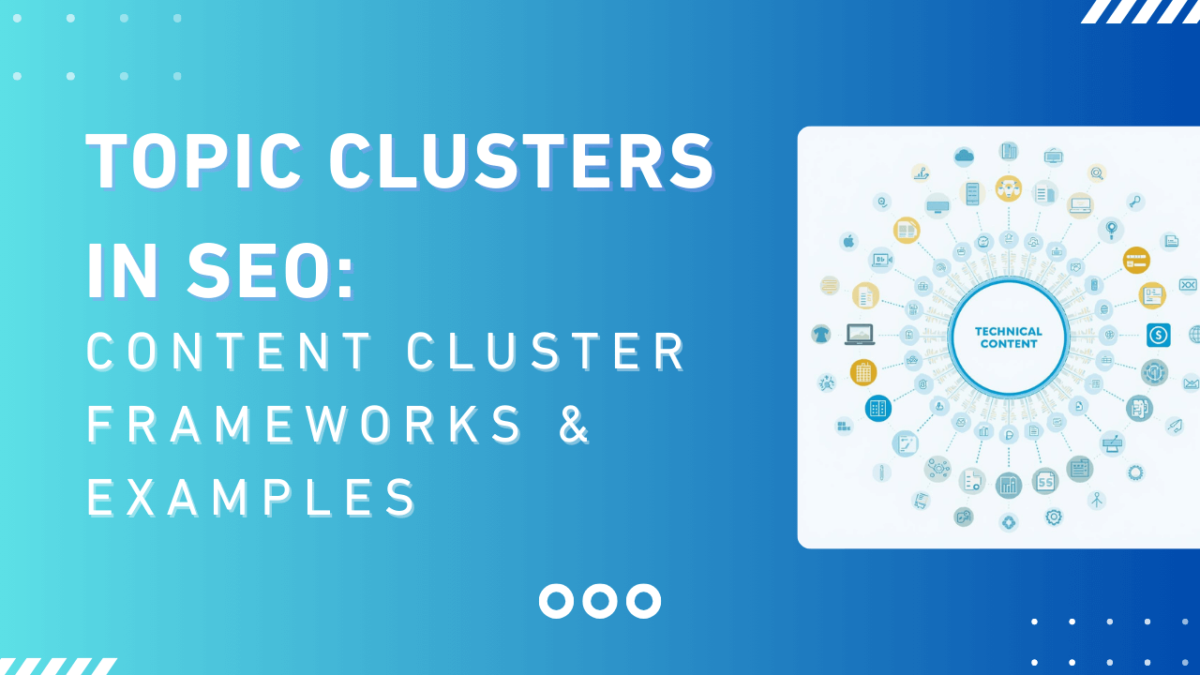
What Are Topic Clusters in SEO?
In SEO, topic clusters are a content structure designed to build topical authority by organizing related pages around a central subject. Instead of optimizing individual pages in isolation, topic clusters connect a primary pillar page with supporting content that covers subtopics, variations, and related search intents.
This structure helps search engines understand not just what a page is about, but how deeply a website covers an entire topic.
Topic Clusters vs Keyword Clusters
Keyword clusters group similar keywords to avoid cannibalization and improve on-page optimization. They focus on ranking efficiency at the page level.
Topic clusters operate at a higher level. They group content by subject matter, not keyword similarity, and are designed to strengthen authority across multiple related queries rather than optimize for a single primary term.
Topic Clusters vs Blog Categories
Blog categories are organizational labels used for navigation and user experience. They do not define content relationships or influence authority flow by default.
Topic clusters are intentionally linked structures. Each page has a defined role, and internal links are used to signal topic relationships and importance to search engines.
Why Google Evaluates Content at the Topic Level
Google evaluates content at the topic level because modern search queries are semantically related rather than isolated. Ranking decisions are influenced by how consistently a site demonstrates expertise across related questions, concepts, and intents. Topic clusters provide clear signals of topical depth and relevance, making them easier for search engines and AI systems to assess and retrieve.
How Topic Clusters Work for SEO
Topic clusters work for SEO by helping search engines understand content relationships, page importance, and topical depth across a website. Instead of evaluating pages in isolation, Google assesses how multiple related pages support a central topic.
Role of the Pillar Page
The pillar page defines the core topic and targets the primary, broad keyword. Its role is not to rank alone, but to act as the authority hub that connects all related subtopics.
A well-structured pillar page:
- Covers the topic at a high level
- Links to all supporting cluster pages
- Receives internal links back from those pages
Role of Supporting Cluster Pages
Supporting pages target specific subtopics, variations, or search intents related to the pillar. Each page focuses on one clear intent and provides depth that the pillar page intentionally avoids.
These pages:
- Rank for long-tail and mid-tail queries
- Strengthen topical relevance of the pillar
- Expand keyword coverage across the topic
Internal Linking Logic
Internal links are the mechanism that makes topic clusters work.
Effective topic cluster SEO follows three rules:
- Cluster pages link up to the pillar page
- The pillar page links down to cluster pages
- Related cluster pages cross-link where contextually relevant
This linking structure signals topical relationships and concentrates authority toward priority pages.
How Authority Compounds Across the Cluster
As supporting pages earn impressions, engagement, and links, those signals reinforce the pillar page through internal linking. Over time, the entire cluster gains visibility across a wider set of related queries.
This is why topic clusters outperform standalone content in competitive SERPs — authority is shared across the structure rather than trapped on individual pages.
The Hidden Decision That Determines Whether a Topic Cluster Works
Most topic clusters fail not because of poor execution, but because the wrong type of cluster is built for the wrong goal. Before structure, content, or internal linking, there is a strategic fork that determines whether a topic cluster will compound or stall.
Demand-Driven Clusters vs Keyword-Driven Clusters
Keyword-driven clusters are built by grouping keywords that look similar or share modifiers. They are optimized for short-term rankings but often lack depth across related search intents.
Demand-driven clusters are built by mapping how users actually explore a topic — from foundational questions to advanced use cases and decisions. These clusters align with how Google evaluates topical coverage and tend to grow visibility across a broader query set over time.
Keyword-driven clusters often rank a few pages.
Demand-driven clusters build authority across the entire topic.
Authority-First Clusters vs Conversion-First Clusters
Authority-first clusters are designed to establish topical credibility before targeting competitive or commercial queries. They focus on depth, explanation, and coverage.
Conversion-first clusters prioritize decision-stage and transactional content early, often without sufficient supporting context.
In competitive SERPs, conversion-first clusters usually underperform because Google expects authority signals before rewarding high-intent pages.
Why Choosing the Wrong Cluster Type Causes Long-Term Underperformance
When a topic cluster is built with the wrong objective:
- Pages compete internally instead of reinforcing each other
- High-intent pages fail to rank consistently
- The cluster stops expanding visibility beyond its initial keywords
This isn’t a short-term issue. The structure itself limits how much authority the cluster can accumulate, making later fixes expensive and slow.
Three Types of SEO Topic Clusters (And When to Use Each)
Not all topic clusters serve the same purpose. In SEO, clusters perform differently depending on whether the goal is authority building, category ownership, or decision-stage capture. Classifying clusters by intent is critical to choosing the right structure.
Problem-Space Topic Clusters
Problem-space clusters are designed to establish problem ownership — becoming the most authoritative source on a specific challenge, workflow, or pain point.
These clusters focus on:
- Definitions, causes, and implications of a problem
- Educational and diagnostic content
- Early- and mid-stage search intent
Problem-space clusters outperform commercial clusters when:
- The category is crowded with similar product pages
- Buyers need education before evaluating solutions
- Authority must be built before targeting competitive keywords
This cluster type creates the foundation that other clusters depend on.
Category & Solution Topic Clusters
Category and solution clusters are built to compete for category-level and solution-oriented SERPs.
They focus on:
- Software categories or service types
- Core use cases and capabilities
- How solutions address specific problems
SaaS and service sites win category-level SERPs when content:
- Covers the full solution space, not just one product
- Structures subtopics intentionally rather than publishing standalone pages
- Reinforces the category narrative through internal linking
Most competitors under-structure this cluster by publishing isolated category pages without sufficient supporting content, limiting their ability to rank consistently.
Comparison & Decision Topic Clusters
Comparison and decision clusters are designed to capture high-intent, late-stage searches.
They include:
- Alternatives and comparison pages
- Feature, pricing, and differentiation content
- Decision-support resources
“Alternatives” content works best inside a cluster because Google expects comparison pages to be supported by broader authority. Without surrounding context, these pages struggle to rank or fluctuate heavily.
When properly structured, decision clusters:
- Rank more consistently
- Support sales and conversions
- Shorten buying cycles by answering evaluation questions clearly
Key takeaway: Effective SEO topic clusters are classified by intent and outcome, not by content format. Using the right cluster type at the right time determines whether a cluster compounds authority or stalls
Real SEO Topic Cluster Examples (Mapped)
Each example below shows how a topic cluster is structured, not what content “sounds like.” The focus is on topic selection, intent layering, and internal linking logic.
Example 1: Problem-Space Topic Cluster
Pillar topic:
Customer churn in SaaS
Supporting cluster topics:
- What causes SaaS churn
- How to calculate churn rate
- Customer churn vs retention
- Early signs of customer churn
- How to reduce churn in SaaS
Search intent per layer:
- Pillar: Broad informational / problem definition
- Supporting pages: Informational → solution-aware
Internal linking direction:
- All supporting pages link to the pillar
- Pillar links to each supporting page
- Related supporting pages cross-link where concepts overlap
Example 2: Category & Solution Topic Cluster
Pillar topic:
Email marketing software
Supporting cluster topics:
- Email marketing tools for small businesses
- Email marketing software features
- Email marketing software pricing models
- Email marketing software use cases
- How email marketing software works
Search intent per layer:
- Pillar: Commercial / category-level
- Supporting pages: Informational → commercial
Internal linking direction:
- Supporting pages link up to the category pillar
- Pillar links down to each use-case and feature page
- Feature and use-case pages cross-link where relevant
Example 3: Comparison & Decision Topic Cluster
Pillar topic:
CRM software alternatives
Supporting cluster topics:
- CRM software comparisons
- Best CRM software for startups
- CRM software pricing comparison
- Open-source CRM alternatives
- CRM software pros and cons
Search intent per layer:
- Pillar: High-intent / comparison
- Supporting pages: Commercial → decision-stage
Internal linking direction:
- All comparison pages link to the alternatives pillar
- Pillar links to each comparison and decision-support page
- Decision pages cross-link to related evaluation content
Key takeaway: High-performing topic clusters are intentionally mapped systems, not collections of related blog posts. Clear intent layering and internal linking direction are what allow these clusters to rank and compound authority.
Topic Cluster Frameworks That Scale SEO
A topic cluster framework defines what type of authority you are building, where it accumulates, and how rankings are earned over time. In competitive SEO, clusters scale only when the framework matches both the site’s authority level and its business objective.
Authority-First Topic Cluster Framework
When to use it
- The site has limited topical authority in the target area
- Competitive keywords consistently stall beyond page two
- The goal is to establish trust before pursuing conversion-driven rankings
This framework is most effective for new topics, new sites, or sites expanding into competitive problem spaces.
What problem it solves
Authority-first clusters solve the issue of insufficient topical credibility. Many SEO strategies fail because they attempt to rank high-intent pages before Google has enough signals to trust the site on the broader topic.
This framework allows authority to be built incrementally by:
- Covering foundational concepts and terminology
- Addressing adjacent and supporting search intents
- Repeating topical signals across multiple related pages
Structural characteristics
- Pillar page targets a broad, informational topic with high semantic coverage
- Supporting pages focus on definitions, explanations, processes, and sub-problems
- Internal links concentrate authority upward toward the pillar
- Minimal commercial intent during the initial phase
How it scales
As authority accumulates:
- The cluster begins ranking for a wider range of related queries
- New supporting pages strengthen existing rankings rather than competing with them
- Commercial pages can be introduced later with higher success rates
How it differs from generic pillar models
Generic pillar models often mix intent types and publish all pages at once. Authority-first frameworks prioritize sequencing, ensuring authority is established before monetization, which leads to more stable long-term rankings
Conversion-Supported Topic Cluster Framework
When to use it
- The site already ranks for related informational queries
- Category or comparison pages exist but fluctuate
- SEO needs to support leads, trials, or revenue
This framework works best when baseline topical authority is already present.
What problem it solves
Conversion-supported clusters solve the problem of isolated commercial pages. High-intent pages often underperform because they lack sufficient contextual reinforcement within the topic.
This framework strengthens commercial rankings by:
- Surrounding high-intent pages with supportive content
- Reducing intent mismatch between pages
- Increasing relevance signals through internal relationships
Structural characteristics
- Pillar page targets a category, solution, or comparison keyword
- Supporting pages include use cases, implementation details, and decision guidance
- Informational content exists to support, not distract from, conversion pages
- Internal links flow from informational and mid-intent pages toward commercial assets
How it scales
As the cluster matures:
- Commercial pages rank more consistently
- Supporting content expands keyword breadth without cannibalization
- Authority compounds around revenue-driving pages
How it differs from generic pillar models
Generic models treat the pillar as an overview. Conversion-supported frameworks treat the pillar as a priority ranking target, with supporting pages explicitly designed to transfer relevance and authority.
Key takeaway: Topic clusters scale when the framework matches the site’s authority stage and intent priority. Choosing between authority-first and conversion-supported frameworks determines whether a cluster compounds or plateaus.
Content Cluster Template (Practical Setup)
This template is designed to build SEO topic clusters that compound authority, avoid cannibalization, and support rankings in competitive SERPs.
You can use this for any industry.
Step 1: Define the Cluster Objective (Mandatory)
Before choosing keywords, lock one primary objective.
Cluster objective (choose one):
- ☐ Build topical authority
- ☐ Support category / commercial rankings
- ☐ Capture comparison & decision-stage demand
❗ If you skip this, the cluster will fragment and underperform.
Step 2: Select the Pillar Topic (Not a Keyword)
Pillar topic rules:
- Broad enough to support 6–12 subtopics
- Represents a topic, not a feature or blog idea
- Has sustained search demand
Pillar topic:
_______________________________
Primary search intent:
☐ Informational
☐ Commercial
☐ Comparison
Primary pillar keyword:
________________________________
Step 3: Map Supporting Cluster Pages by Intent
Each supporting page must serve one clear intent.
| Page Type | Topic | Primary Intent | Links To |
| Supporting Page 1 | Informational | Pillar | |
| Supporting Page 2 | Informational | Pillar | |
| Supporting Page 3 | Solution-aware | Pillar | |
| Supporting Page 4 | Use-case | Pillar | |
| Supporting Page 5 | Comparison / Decision | Pillar |
Rules:
- One page = one intent
- No overlapping scopes
- No duplicated keyword targets
Step 4: Define Internal Linking Rules (Non-Negotiable)
Mandatory linking structure:
- Every supporting page links to the pillar
- Pillar links to every supporting page
- Supporting pages cross-link only when contextually required
Anchor text rules:
- Use descriptive, intent-based anchors
- Avoid repeating the exact same anchor across all links
Step 5: Set Scope Boundaries (Prevents Cluster Failure)
For each page, define what it will not cover.
Example:
- This page will NOT include pricing
- This page will NOT compare tools
- This page will NOT explain basic definitions
This prevents:
- Overloaded pillar pages
- Cannibalization
- Internal competition
Step 6: Content Depth Guidelines (Minimum Standards)
Pillar page must:
- Cover the topic at a high level
- Act as a navigation and authority hub
- Avoid deep dives
Supporting pages must:
- Fully satisfy one intent
- Go deeper than the pillar
- Introduce terminology and context naturally
Step 7: Publishing & Expansion Plan
Initial cluster size
- Pillar + 4–6 supporting pages
Expansion triggers:
- New keywords entering top 20–30
- Repeated impressions for uncovered subtopics
- Supporting pages ranking independently
Add new pages only when they reinforce the cluster.
Step 8: Cluster-Level Success Metrics
Track clusters as systems, not pages.
Key metrics:
- Keyword breadth growth across the topic
- Pillar page ranking stability
- Supporting pages lifting each other
- Impressions increasing before traffic
One-Line Rule to Remember
If a page doesn’t strengthen the cluster, it doesn’t get published.
Do Topic Clusters Still Matter for AI Search?
Yes. Topic clusters matter more for AI search because large language models retrieve information based on topic completeness and content relationships, not individual pages.
Why Topic Clusters Improve AI Retrieval
AI systems prioritize sources that demonstrate consistent coverage across a subject. Topic clusters make it easier for models to:
- Identify authoritative sources on a topic
- Understand relationships between concepts
- Retrieve accurate, context-rich answers
When content is structured as a cluster, AI can reference the site as a topic-level source, not just a single page.
How Structured Coverage Helps Citations
LLMs prefer citing sources that:
- Clearly define concepts
- Cover related questions without contradiction
- Present information in predictable, extractable formats
Topic clusters naturally support this by separating concepts into focused pages while reinforcing them through internal links. This reduces ambiguity and increases the likelihood of being selected as a reference.
What Not to Over-Optimize for AI
Over-optimizing for AI often reduces effectiveness.
Avoid:
- Writing content solely for AI summaries
- Forcing repetitive definitions across pages
- Overusing schema or artificial Q&A formats
The same principles that build topical authority for SEO — clarity, depth, and structure — also support AI retrieval without additional manipulation.
Key takeaway: Topic clusters remain relevant because both search engines and AI systems rely on structured, comprehensive topic coverage to evaluate and retrieve information.
Conclusion
Topic clusters are not an optional SEO tactic. They are the structural layer that allows content to rank, compound, and remain defensible in competitive search environments.
Whether for traditional SEO or AI-driven retrieval, search systems reward clear topic ownership, consistent coverage, and intentional content relationships. Topic clusters provide that structure by turning individual pages into a connected authority system rather than isolated assets.
When built around real demand, the right cluster framework, and disciplined internal linking, topic clusters scale visibility in ways standalone content cannot. The advantage is not publishing more — it’s structuring content so authority accumulates over time.
FAQs
There is no fixed number. A site should have as many topic clusters as it can support with depth and internal reinforcement. In practice, most sites perform better with a few well-developed clusters than many thin ones. Each cluster should represent a topic the site intends to own long-term, not a short-term keyword opportunity.
Yes, but only when the relationship is conceptually valid. Cross-cluster links should reinforce topical adjacency, not flatten the site structure. Excessive or forced cross-linking can dilute authority signals and make it harder for search engines and AI systems to identify clear topic ownership.
Topic clusters reduce cannibalization by assigning one primary intent per page and defining clear scope boundaries. When pages are planned as part of a cluster, overlap is intentional and hierarchical rather than accidental, allowing Google to understand which page should rank for which type of query.
No. Pillar pages should be the most comprehensive at a high level, not the most detailed. Depth belongs in supporting cluster pages. Overloading pillar pages with excessive detail often weakens clarity and reduces their effectiveness as authority hubs.
Topic clusters improve internal authority distribution, but they do not replace backlinks. External links accelerate trust and ranking potential, especially for competitive topics. Clusters work best when backlinks point to either the pillar page or key supporting pages, allowing authority to flow through the structure.
Topic clusters should be expanded when data shows uncovered demand. Signals include recurring impressions for related queries, supporting pages ranking independently, or competitors ranking for subtopics not yet covered. Expansion should be demand-led, not calendar-driven.
No. Topic clusters are useful for smaller sites precisely because they concentrate authority. A small site with one strong cluster often outperforms a larger site publishing disconnected content. The key is choosing topics that match the site’s realistic authority ceiling
Yes. AI systems favor sources that show consistent, structured coverage of a topic. Topic clusters reduce ambiguity, improve concept clarity, and increase the likelihood that content is retrieved and cited as a reliable reference rather than a one-off answer.
Topic clusters are unnecessary for single-intent topics, low-competition queries, or pages that do not benefit from surrounding context. In these cases, a standalone, well-optimized page can perform better without the overhead of cluster planning.